1.5–2 Inches Front Ivy League Haircut: Exact Barber Scripts for Men

Updated: Aug 28
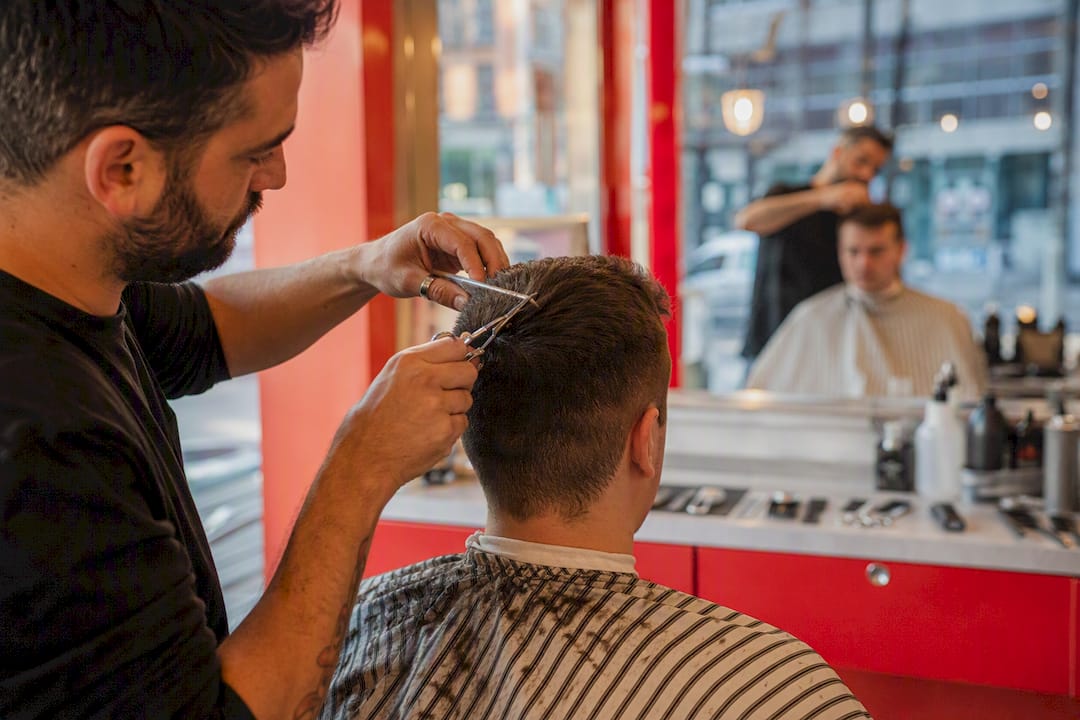
The Ivy League haircut is a longer crew cut with top hair left long enough to part and sweep to one side, tapered or faded on the sides. It suits most professionals, students, and anyone who wants a low-to-moderate maintenance style that reads sharp in a boardroom and still looks natural on a Saturday. Manhattan Barbershop cuts this style regularly and treats the top-to-side graduation as the detail that separates a good Ivy League from a mediocre one.
Make sure the front length is between 1.5 and 2 inches,graduated smoothly into 0.5 to 1 inch at the crown to avoid a shelf effect.
Choose between a classic taper or a sharper low fade based on your maintenance preference, with fades needing touch-ups every two to three weeks.
Use precise measurements and guard numbers when describing the cut to your barber, emphasizing the graduation and side part for accurate results.
Style the haircut with a light pomade or matte clay, working it through damp hair, and use a fine-tooth comb or fingers depending on the desired finish.
Schedule trims every 3 to 4 weeks for a classic taper or 2 to 3 weeks for fades, focusing on maintaining the graduation and clean side part.
Table of Contents
What Is an Ivy League Haircut, Exactly?
An Ivy League haircut is a crew cut variation with the top left long enough to part at the side, distinguishing it from a standard crew cut that stays short and forward brushed everywhere. Front length typically runs 1.5 to 2 inches, with the crown graduated down to 0.5 to 1 inch). That gap between front and crown is what lets the top fall into a side part instead of standing up on its own.
Graduation is the technical term for that front-to-crown length transition, and it matters more than most guys realize. Cut it too abruptly and you get a shelf effect, where the hair looks like it stops rather than tapers. Done right, the length decreases gradually enough that the part looks intentional from any angle, not just straight on.
The style goes by a few other names, and knowing them helps when you’re talking to a barber who trained somewhere that uses different terminology. It is also called the Harvard clip or the Princeton, and some barbers will offer a short pompadour or forward brush finish as an alternative to the classic swept side part.
Here’s how the core elements break down:
Top length: 1.5 to 2 inches at the front, graduated to 0.5 to 1 inch at the crown
Sides: Tapered or faded, ranging from a conservative taper to a sharper low fade
Part: A defined side part, usually on the side that matches the natural hair growth pattern
Finish: Combed and swept, not spiked or textured like a modern quiff
One old-school detail worth mentioning: barbers used to finish this cut with butch wax, a heavy-hold wax originally made for military-style crew cuts. Most guys today reach for a lighter pomade or matte clay instead, which gives similar hold without the stiff, shellacked look butch wax produces — for tips on choosing appropriate corporate headshot attire to complement your polished finish.
What Are the Best Ivy League Haircut Variations?
The classic Ivy League is really a starting template. How you taper the sides, texture the top, and finish the style changes both the look and how often you’ll need to see your barber. Picking the right variation comes down to your hair type, your daily routine, and how sharp you want the contrast between top and sides.
The classic taper is the safest bet and the most forgiving version of the cut. Sides are tapered gradually with no hard line, front length sits around 1.75 to 2 inches, and the whole thing reads conservative enough for law firms, client meetings, or a first job. This is the version to request if you’re not sure what you want yet. It photographs well, grows out evenly, and never looks dated.
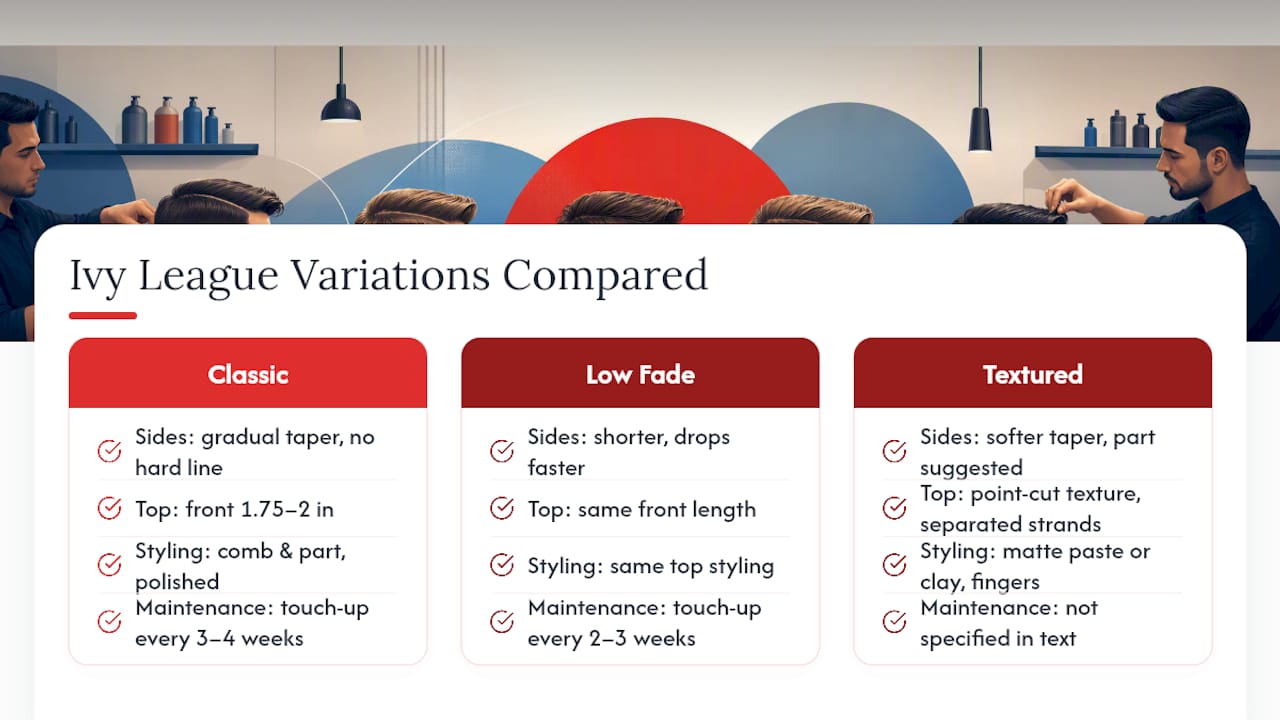
The low fade Ivy League trades that forgiving blend for sharper contrast. The sides drop shorter, faster, creating a visible line between skin and hair that makes the top length pop. It looks more current and works well for guys who want the same top styling with a more aggressive edge, but it comes with a real tradeoff: fades need touch-ups roughly every two to three weeks to keep that clean line, compared to three to four weeks for a standard taper.
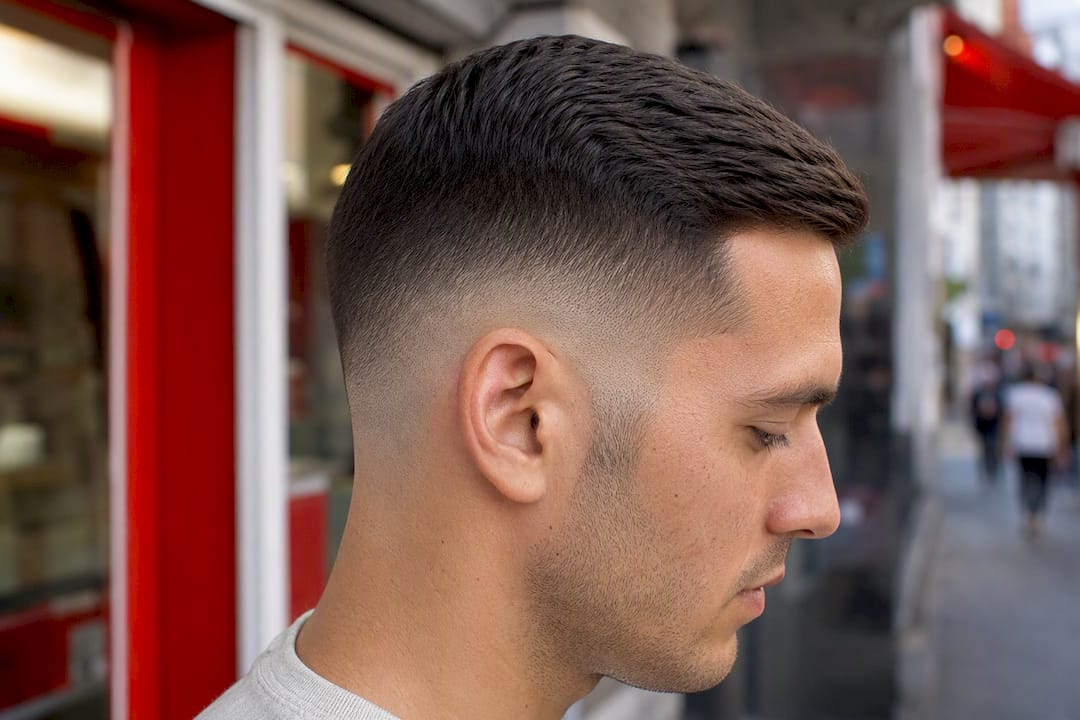
The textured or modern Ivy League skips the polished comb-and-part look for something looser. Instead of a wet comb finish, the barber point-cuts the top to break up density and create separation between strands. Styling calls for a matte paste or clay worked through with fingers rather than a comb, and the side part becomes more of a suggestion than a hard line. This textured approach is one of the more common modern adaptations of the traditional cut, alongside fades and undercut-style side tapers.
Curly and long-hair versions need a different approach entirely. If you have natural curl, cutting straight to the standard measurements can shrink the visible length once curls spring back up, so barbers often leave extra length in the front to compensate. The goal is preserving curl pattern on top while still keeping enough taper on the sides that the cut reads as an Ivy League rather than an undefined curly crop.
Short and military-adjacent variants exist too, but there’s a line where they stop qualifying as an Ivy League. Once the front length drops much below 1.5 inches, you lose the ability to create a real side part, and at that point you’re back to a standard crew cut. If low maintenance is your priority above everything else, our guide to low-maintenance haircut styles covers where that line sits for different lifestyles.
Bringing reference photos helps more than almost anything else you can do before a haircut. Bring photos that show the front sweep, the crown area, and a side profile, and if you’re torn between a polished finish and a textured one, bring examples of both so your barber can talk through which suits your hair density.
What Do You Actually Say to Get an Ivy League Cut?
Walking into a barbershop and saying “give me an Ivy League” works with an experienced barber, but specifics protect you from a miscut. The clearest way to describe it is a longer crew cut with a side part, then follow with exact numbers.
Here are three scripts, one for each common version:
Classic Ivy League: “I want a longer crew cut with a side part. Front around 2 inches, graduated down to about three-quarters of an inch at the crown. Sides tapered, no hard line, blend it with scissors around my ears.”
Ivy League with a low fade: “Longer crew cut, side part, front at 2 inches tapering to the crown. Sides on a low fade, skin fade at the bottom blending up to a number 3 or 4 on top of the fade.”
Short, low-maintenance Ivy League: “Shorter version of a longer crew cut, front around 1.5 inches, crown close to half an inch. Sides at a number 2 guard, keep it tight so I can go longer between trims.”
This “longer crew cut with a side part” framing is the phrase that gets barbers who haven’t heard “Ivy League” by name onto the same page fastest, followed by the guard number or inch measurement.
Guard numbers matter because they translate your intent into something the clippers can execute consistently. Guards from #2 to #5 cover most Ivy League side lengths, with #2 giving a tighter, higher-contrast look and #5 blending closer to the top length for a softer transition. Scissor tapering is the alternative for sides, and it usually produces a smoother gradient than clipper guards alone.
Ask specifically for scissor-over-comb around the ears and along the neckline. This technique lets the barber follow the curve of your head rather than cutting in the flat steps a clipper guard creates, which matters most in areas where the skull shape changes quickly.
Pro Tip: Take a phone photo of your current cut before you sit down, even if it’s grown out. It gives your barber a fast read on your natural growth pattern and cowlicks, which speeds up the consultation and reduces surprises.
Before you sit in the chair, run through a short mental checklist: which side you want the part on, how your neckline should sit (natural versus shaved), how much texture you want left on top, and how high you want any fade to start. Walking in with answers to those four questions turns a 20-minute consultation into a five-minute one. For more on building that kind of shorthand with your barber, see our piece on finding a barber who matches your style.
How Do You Style an Ivy League Haircut at Home?
Styling this cut takes less time than most guys expect once the muscle memory sets in, usually under ten minutes start to finish. The routine changes slightly depending on whether you want a polished, textured, or casual look.

Start with the right moisture level. Towel-damp hair holds product better than fully dry hair, but soaking wet hair dilutes pomade too much to give real hold. If your hair air-dries fast, mist it lightly before applying anything.
For the classic side part, here’s the routine:
Work a dime-sized amount of light pomade between your palms until it’s evenly warmed and spread.
Apply from the crown forward, then comb the part in with a fine-tooth comb while hair is still damp.
Sweep the front section across and slightly back, following the direction the graduation was cut to support.
Let it air-dry or use a blow dryer on low heat with a comb to lock the shape as it sets.
For a textured, matte finish, skip the comb entirely:
Rub a small amount of matte clay or paste between your fingers, not your palms, so it stays concentrated.
Work it through damp hair with your fingertips, focusing on the top and lifting slightly at the roots.
Push the front section to one side using a raking motion rather than a smooth sweep.
Let it dry naturally for a piece-y finish, or blast briefly with a dryer for extra separation.
For a casual sweep on days you want minimal effort, apply almost no product, a pea-sized amount at most, and use a blow dryer with your fingers to push the front over while it’s still slightly damp. This works best on the classic taper or textured variation, less well on a heavily faded cut where the contrast needs more deliberate shaping.
Fine hair benefits from lighter products that add texture without weight, since heavy pomades flatten fine strands fast. Thick or coarse hair can handle stronger hold products and often looks better with slightly more product overall to control frizz and flyaways.
Pro Tip: If your part keeps drifting throughout the day, you’re probably applying product to dry hair. Product grips damp hair better and holds the part in place far longer.
How Often Should You Trim an Ivy League Haircut?
Trim frequency depends entirely on which variation you’re wearing, and getting this wrong is the most common reason guys feel like their Ivy League “grows out ugly.”
Classic taper: every 3 to 4 weeks
Low or mid fade: every 2 to 3 weeks
Longer Ivy League (minimal taper, more length overall): every 4 to 6 weeks
These cadences reflect how fast each variation loses its defining shape: fades grow out fastest because the sharp line between skin and hair softens within days, while a longer, softer taper can drift for weeks before it looks noticeably different.
Between visits, keep the part clean by running a comb through damp hair each morning rather than relying entirely on old product residue. A quick trim of stray hairs around the ears with small scissors can buy you a few extra days if a fade starts looking shaggy before your scheduled appointment.
At maintenance visits, be specific about what you want preserved. Say something like “keep the same graduation, just clean up the sides” rather than just “same as last time,” since barbers see dozens of clients between your visits and specific language helps them match the exact taper you had before. If your side part has started to look inconsistent, our deep dive on the side part covers how to communicate small adjustments.
One maintenance mistake worth flagging: piling on pomade to disguise a cut that’s grown past its shape. Heavy product on overgrown hair usually looks greasy rather than styled. If you’re reaching for more product every day just to get the same result, that’s a sign you’re overdue for a trim, not a sign you need a stronger pomade.
Which Face Shapes and Hair Types Suit This Cut?
Oval face shapes handle almost any Ivy League variation without adjustment, since the cut’s natural top-to-side ratio already balances most proportions well. Square and rectangular faces benefit from slightly more length and softness on top, which breaks up strong jawlines rather than emphasizing them with a tight, close-cropped side.
Hair type changes the styling approach more than face shape does:
Fine hair: ask for slightly more length on top and point-cutting to fake density, since flat-cut fine hair on a short style tends to look thin
Thick or coarse hair: ask the barber to remove bulk at the crown so the top doesn’t sit like a helmet
Curly hair: keep a bit more front length than the standard 1.5 to 2 inches to account for curl shrinkage once it dries
Cowlicks at the crown: flag this before the cut starts, since over-shortening the crown relative to the front is a common cause of stubborn cowlicks, and an experienced barber will adjust graduation around your specific growth pattern instead of applying a standard taper
Uneven growth patterns are more common than most guys realize, and a good consultation catches them before the clippers come out, not after. If you’re unsure how your specific hair type holds up to this style, our guide to hair type and cut compatibility breaks down more type-specific adjustments.
How Manhattan Barbershop Approaches the Ivy League Cut
Clean fades and classic cuts are the backbone of what we do at Manhattan Barbershop, and the Ivy League sits right at the intersection of both. Scissor work carries more weight in this cut than in almost any other style we do, because the top requires nuanced tapering rather than the fixed steps a clipper guard produces on its own.
We judge graduation individually for each client’s skull shape rather than applying a one-size measurement. A rounder crown needs a different transition than a flatter one, even at the same front length, and that decision gets made in the chair, not before you sit down.
Consultation is where most of the real customization happens. We’ll ask about your daily styling habits, how much time you actually spend in the mirror each morning, and whether you’ve had cowlick or growth pattern issues before, then adjust the plan around honest answers rather than a generic template. Clients who’ve worked with us on repeat visits tend to shift toward less product over time, once the cut itself is doing more of the work.
Where Did the Ivy League Haircut Come From?
The Ivy League haircut traces its roots to Northeastern American college campuses in the 1950s, particularly the schools that make up the actual Ivy League athletic conference, where the style became something close to a uniform among students and young professionals. It grew directly out of the military crew cut that dominated men’s grooming through the 1940s and early 1950s, but softened it for civilian life by leaving enough length on top to part and style.
That connection to the crew cut is why the two styles still get confused constantly. The crew cut prioritizes uniform shortness everywhere, a legacy of its military function where practicality outranked personal style. The Ivy League kept the short, tidy sides but gave the top enough room to express some individuality, which fit the preppy, buttoned-up aesthetic of mid-century campus life.
The names Harvard clip and Princeton cut come directly from that campus association, and both terms still appear in barber shops today, sometimes used interchangeably with Ivy League and sometimes treated as slightly distinct variants depending on regional barbering tradition. The style faded from mainstream fashion through the more experimental hair decades that followed, then found renewed popularity as a wider return to classic, tailored grooming took hold in menswear over the past decade.
What’s stayed consistent across seven decades is the core logic: enough length to style, short enough to stay professional. That balance is exactly why the cut never fully disappeared.
Why the Ivy League Beats Most “Trendy” Alternatives Right Now
Most style guides treat the Ivy League as a fallback option, the safe cut you pick when you don’t want to commit to something bolder. That framing undersells it. The real advantage isn’t safety, it’s precision. This is one of the few classic men’s cuts where exact measurements actually determine how the style performs day to day, not just how it looks the moment you leave the chair.
The conventional advice, “ask for an Ivy League and see what happens,” fails more often than it should. Barbers interpret the name differently depending on training and region, which is exactly why specific inch measurements and guard numbers matter more here than for most requests. A front length of 1.75 inches versus 2.25 inches changes your entire morning routine, not just your appearance.
If there’s one thing readers should prioritize, it’s communicating graduation clearly, not just top length. Most miscuts happen because the crown gets cut too aggressively relative to the front, creating that stubborn cowlick problem barbers deal with constantly. Get the graduation right, and the rest of the style takes care of itself with minimal daily effort.
— Evgenii
Book Your Ivy League Haircut at Manhattan Barbershop
Manhattan Barbershop built its reputation on clean fades, classic cuts, and scissor craftsmanship that holds its shape for weeks, not days, which makes it a natural fit for a style that lives or dies on precise graduation. Our barbers take the time to read your hair density and growth pattern before a single cut happens, so the Ivy League you leave with is tailored to your head, not a generic template.
When you book, mention which variation you want (classic taper, low fade, or textured) and be ready to discuss your part side and neckline preference during consultation. Every appointment includes a real conversation about what you want, scissor-over-comb blending where it counts, and a finish that photographs well without relying on heavy product. You can book your appointment online, and walk-ins are welcome if you’d rather swing by in person. First-time clients curious about the process can also check out our free model haircut offer to see the craftsmanship firsthand before committing to a regular schedule.
Sources
Recommended
Comments